Munsyari sits at around 2,200 m in Pithoragarh district, on a ridge below the five summits of Panchachuli, at the end of the road that runs up the Johar valley towards the Milam glacier. It is a small town in a big landscape, and it has been a wool town for as long as anyone has written it down.
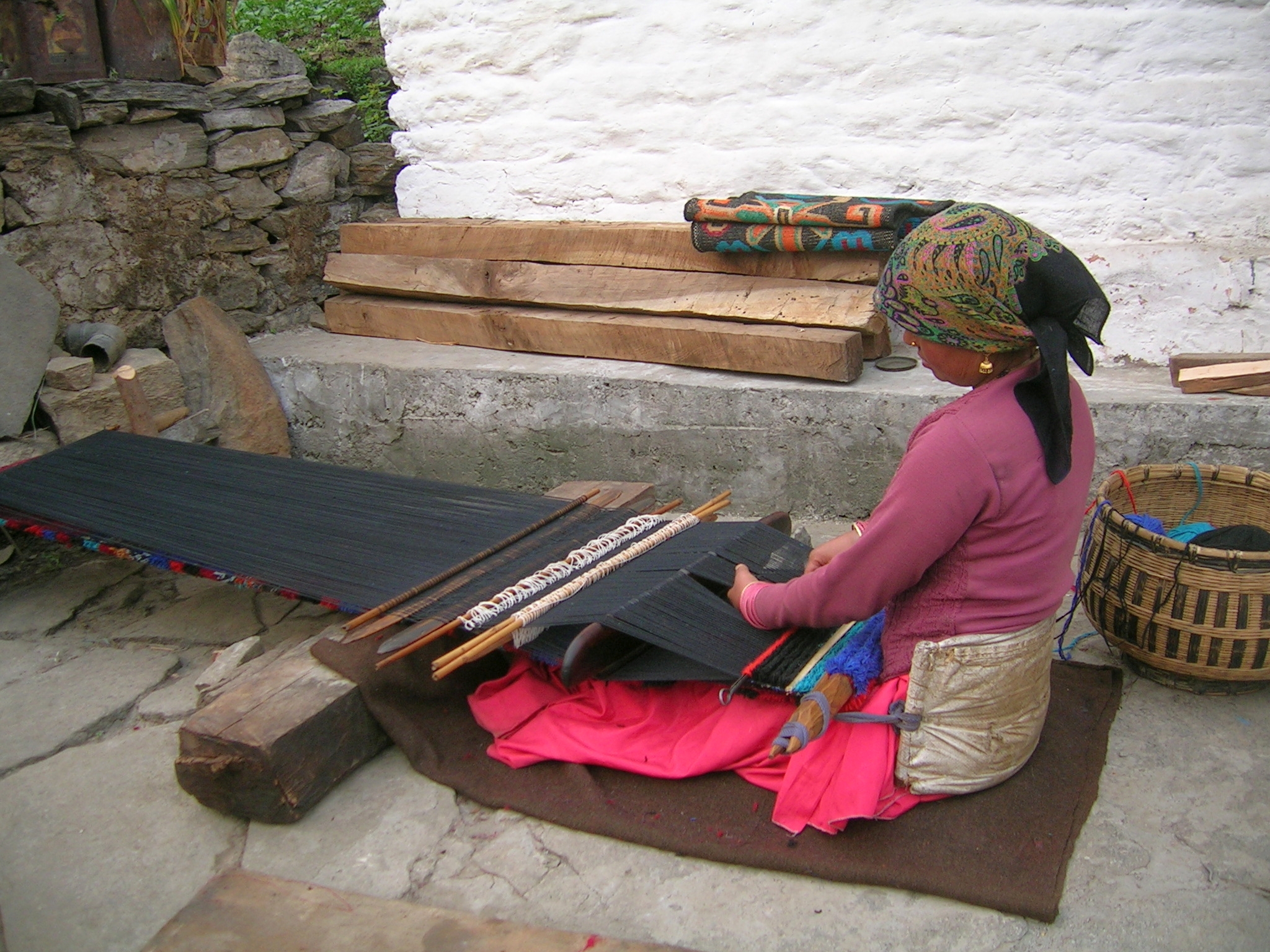
The craft here is Bhotia — the weaving tradition of the trans-Himalayan communities of the high Kumaon — and the villages around Munsyari and Dharchula are still where it lives. This is what they make, what it is made from, and how to tell a hand-knotted Dann from a machine-made rug.
The trade behind the loom
The Bhotia communities of the Johar and Byans valleys built their economy on trade across the passes into Tibet. Wool was one of the goods that came back down — with salt and borax — and one of the goods that went back up. Munsyari was the market town at the foot of that route, where the caravans assembled and where the wool was sold on.
That trade ended in the early 1960s, after the border conflict closed the passes. What was left was the wool itself and the skills that had grown around it, and weaving became the livelihood that replaced the caravans.
What the loom makes
- Bhotia Dann — the hand-knotted carpet, and the most substantial thing made here. Each knot is tied by hand into a wool warp, in traditional Bhotia patterns, using wool from local sheep and, in the better work, natural dyes. It is a slow object: a full carpet takes months, and a well-made Dann is expected to last twenty to forty years. The Government of India's tourism platform lists Bhotia Dann among Uttarakhand's signature crafts, describing it as the work of the state's Bhotia community.
- Thulma — the thick, heavy blanket, woven plain and then napped so the surface comes up soft. This is bedding rather than decoration, and it is the item most Kumaoni households actually own. Thulma is one of Uttarakhand's geographical-indication products, registered for the weavers of Uttarkashi — the same blanket, made the same way, as the one on the Munsyari loom.
- Chutka — a pile blanket, lighter and more compact than a thulma.
- Pankhi — a twill shawl, the woven wrap of the Bhotia tradition, usually in a plain or lightly striped ground.
- Everything else the winter needs — shawls and stoles, sweaters, coats and trousers, caps, socks, mufflers and gloves.
Wool, and now angora
The base is sheep wool from the flocks of the high valleys: shorn in the autumn, washed, carded by hand and spun on a traditional wheel before it ever reaches a loom. Hand-spun wool is softer and lighter than mill-spun at the same warmth, which is why the hand-spun pieces cost more and feel different.
Angora rabbit rearing was promoted in the Munsyari and Dharchula belt as a supplementary income, largely for women, and it has taken hold — Darkot, the next village along from Munsyari, is now known for it. Angora is very fine, very soft, naturally white and a strong insulator, and angora caps, stoles and mufflers now sit in the Munsyari market beside the sheep-wool goods.
The craft today
Spinning and weaving here are household work, and much of it is women's work. The wool comes from the family flock or from neighbours; the loom is in the house; the finished goods go to the market in Munsyari or down to the towns.
Saras Bazar, the state rural-products outlet in the Munsyari market, is where the local wool goods are gathered — angora caps, shawls, sweaters, mufflers, socks, gloves and pankhi — and it is the easiest single stop if you want to see the range in one place. What is much harder, for the weaver, is keeping the value of a hand-knotted carpet in the hills: a Dann that takes months to make often leaves the village long before the buyer ever sees it.
Telling a Dann from a machine carpet
- Turn it over. A hand-knotted Dann shows a grid of individual knots on the back. A machine-made rug shows a flat, uniform backing.
- Look at the edge. Hand-finished selvedges are slightly uneven; machine edges are perfectly straight.
- Read the colour. Natural dyes vary gently across a field. Synthetic dyes sit flat and identical from corner to corner.
- Weigh it. Pure wool is dense and heavy for its size.
- Ask where it was woven. The Dann belt is the Munsyari and Dharchula villages, and a seller who can name the village is a seller who knows the loom.
Where to buy / Local merchants
None of the places below is a partner of Kumaon Escapes and nothing here is an endorsement. They are public listings we found and checked, gathered so you know where to look. We take no payment from them, we do not sell their products, and we have not been asked to recommend them. Stock, hours and prices change — check before you travel.
In and around Munsyari
- Saras Bazar, Munsyari — Where to explore. The state rural-products outlet in the Munsyari market, stocking local wool goods — angora caps, shawls, sweaters, mufflers, socks, gloves and pankhi. A marketplace rather than a single seller.
- Taru Rawat Angora Rabbit Products, Darkot — Local merchant. Angora rabbit wool goods made in Darkot, the next village along from Munsyari, by a village entrepreneur whose work has been covered in local travel films and posts.
- Munsiyari House — Organic Pahadi Store, Munsyari — Local merchant. A hill-products shop selling local organic and pahadi goods, including herbal teas and craft items. Public directory listings also show a Kausani branch.
Craft outlets further down the region
- Kausani Shawl Factory, Pingalkot / Dauni — Craft outlet. The weaving workshop north of Kausani, selling woollen shawls and handicrafts from the premises.
- Kurmanchal Shawl Factory, near the tea factory, Kausani — Craft outlet. A shawl and woollen-goods workshop on the Kausani tea-factory stretch, named in local travel accounts rather than on a website of its own.
- The Pahari Store, Nainital — Craft outlet. A Nainital shop near Capital Cinema carrying Kumaon hill products and crafts.
A note before you buy
A hand-knotted Dann is a months-long object, and it should be priced like one. If a rug is being sold as hand-knotted at a price that makes that impossible, it is worth asking to see the back of it. Equally, if you are buying a thulma or a pankhi for use rather than for the wall, buy the one that feels right in the hand — the craft is a working one, and it is meant to be slept under and worn.
Sources & further reading
Compiled from the following public sources. Verify details with the source before relying on them for travel.
- Bhotia Dann of Uttarakhand — Incredible India
- Bhotia wool weaving — Impart
- History and functioning of the traditional woollen industry in the Munsyari region — Andjournal
- Textile of Uttarakhand: Thulma, Pankhi and more — Baaduli
- Bhotiyas and Himalayan wool — Himalayan Weavers
- Munsiyari — Wikipedia
Lead photograph: Pranavspn / Wikimedia Commons (CC BY-SA 3.0)